
Still Standing After All These Years
Part 15: The Alex Theatre, 1925 to 2025
By Katherine Peters Yamada, August, 2025
Photos from Glendale History Room unless otherwise noted.
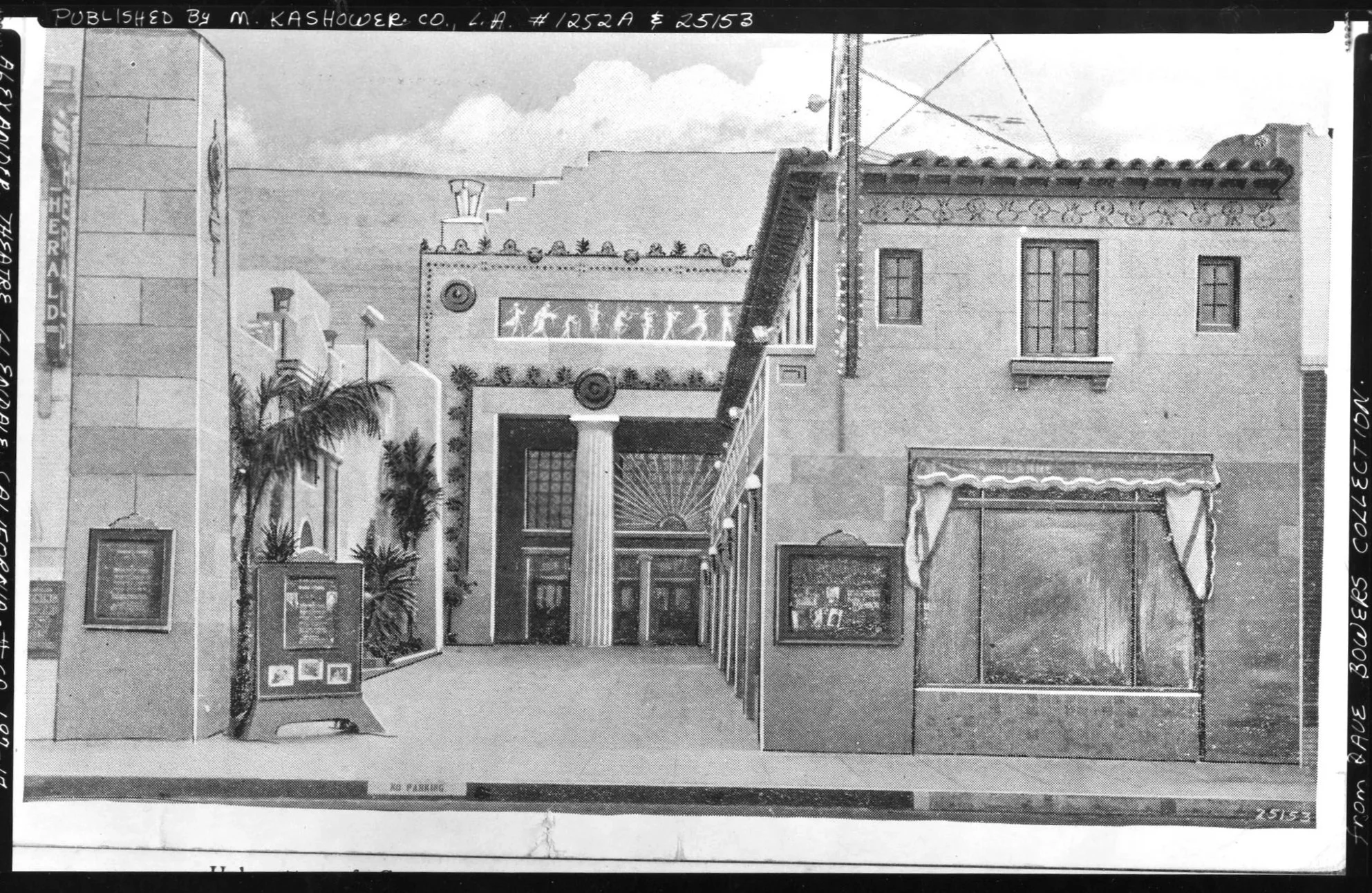
Glendale was growing rapidly when the Alexander Theatre opened in 1925. New residents were buying lots as fast as developers laid them out. Schools were built and churches sprouted all over town.
Brand Blvd. hosted the three-story, 1922 Pendroy Dry Goods and the 1924 Security Trust and Savings Bank (which soared six stories). Another six-story building, Hotel Glendale, designed by architects Arthur G. Lindley and Charles R. Selkirk Associates, opened in July 1925.
And, that September, another Lindley and Selkirk design, a ‘palatial’ movie theater, opened on Brand, in the heart of town.
Palatial Theaters
‘Palatial’ theaters first came on the scene in 1913 in New York City. According to Wikipedia, they made “the average citizen feel like royalty,” with larger seating areas, air conditioning, and, sometimes, childcare.
By 1922, over 4,000 such places had opened. The first on the West Coast, Los Angeles' Million Dollar Theatre, opened in 1918. So, in some ways, Glendale’s prestige theater was a bit late in movie palace history. But it was huge for Glendale. As early as 1922, local newspapers heralded plans for the future theater. Named for Alexander Langley, son of a Langley official, it was said to be larger than many of the palatial movie houses then going up.
Selkirk and Lindley, working with the West Coast-Langley Theatre Circuit, took their architectural cues from the recent discovery of King Tut’s tomb. Built by Kinne and Westerhouse, Engineering and Contractors, it was decorated by Robert E. Powers Studios. The courtyard separating the ticket booth from the lobby was inspired by Grauman’s. A two-story structure occupied the south half of the lot.
A special edition Glendale Daily Press (28,000 copies were printed!) announced the premiere on September 4, 1925. Searchlights signaled the grand opening of the 2,000-plus seat theater. It was packed for two performances, with overflow crowds filling other local theaters. Twenty-five movie stars, including Rin-Tin-Tin, were introduced onstage.
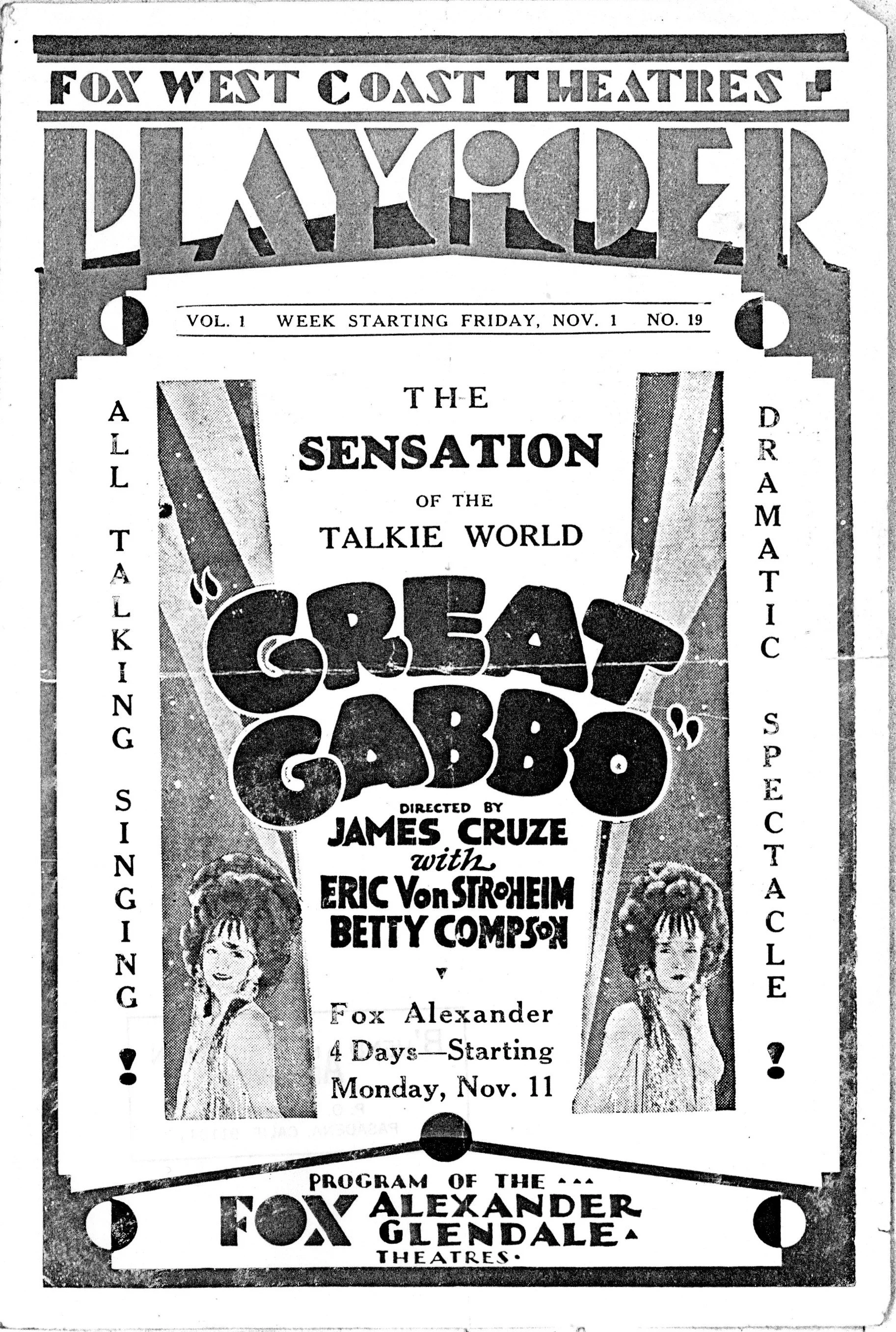
The theater featured vaudeville performances, plays and silent movies (with an organist playing the huge $40,000 Wurlitzer pipe organ). In 1929, Great Gabbo, ‘The Sensation of the Talkie World’ was shown at the Fox Alexander.
Due to its proximity to film studios, the Alexander became the go-to place for movie previews; bringing in celebrities such as Alice Faye, Don Ameche, Elizabeth Taylor (for National Velvet) and Bing Crosby for Going My Way (both 1944). Walt Disney's Hyperion studio was just a few miles away and it is said that Disney cartoons were often previewed here. During the 1930's, as vaudeville declined, the Alexander was also used as a public auditorium.
Dramatic Changes In 1940s
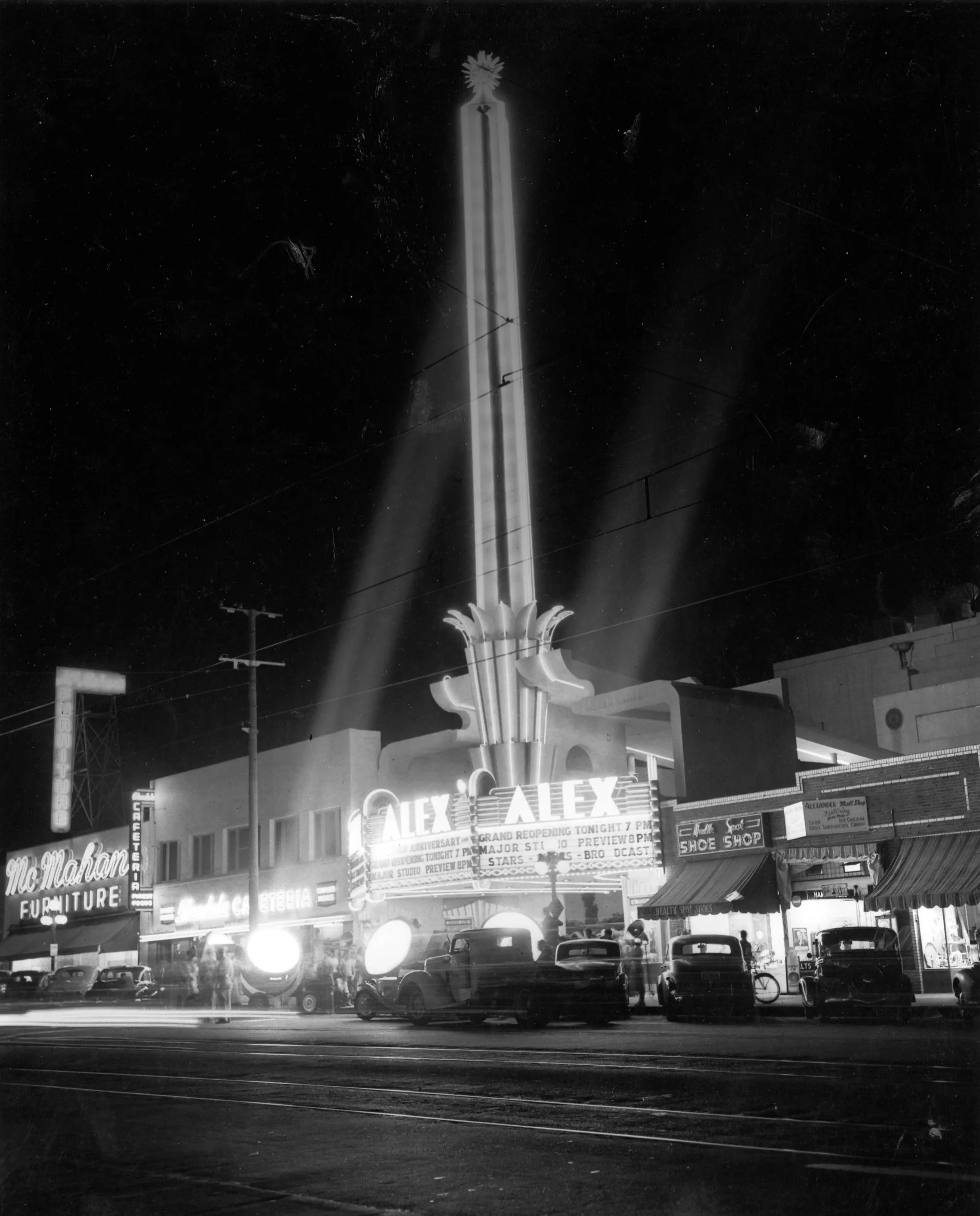
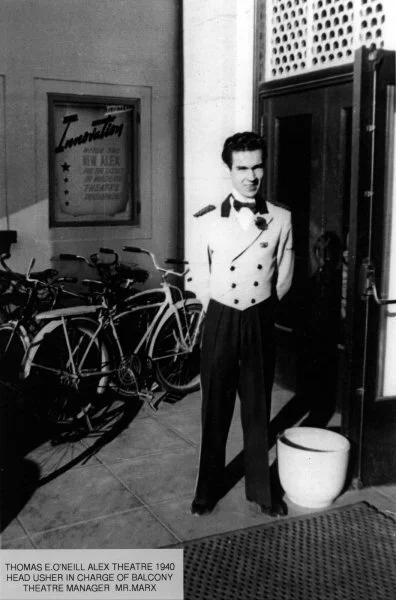
In 1940, S. Charles Lee, well known for his work on the nearby Tujunga Theatre and several downtown LA theaters, redesigned the exterior. The two-story building was eliminated, creating the current wide forecourt.
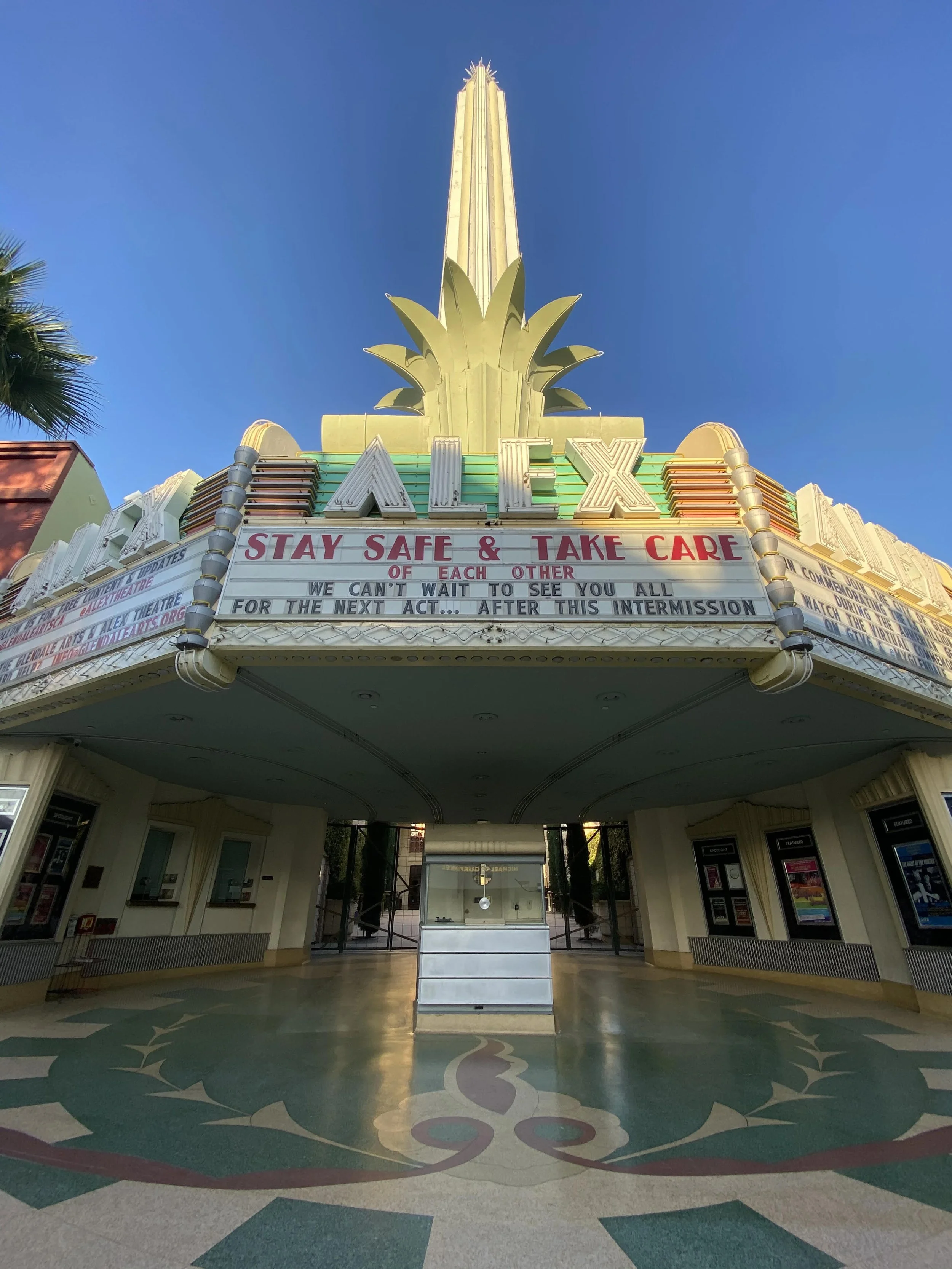
A street-side box office was added, along with a large marquee and a neon-lighted 100-foot column, topped by a spiked, neon sphere creating a starburst effect, as noted in Wikipedia. The new marquee boasted a new name, Alex.
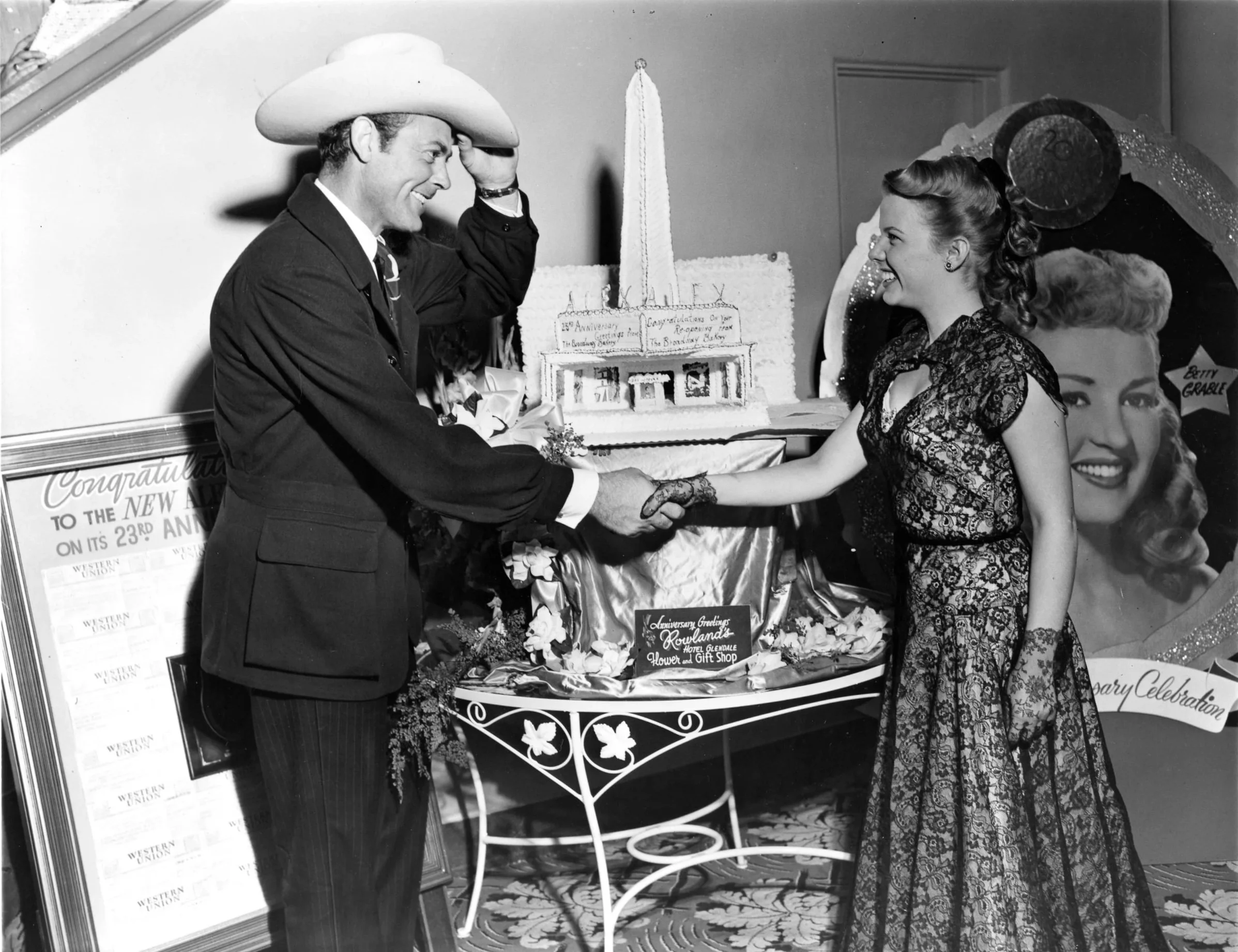
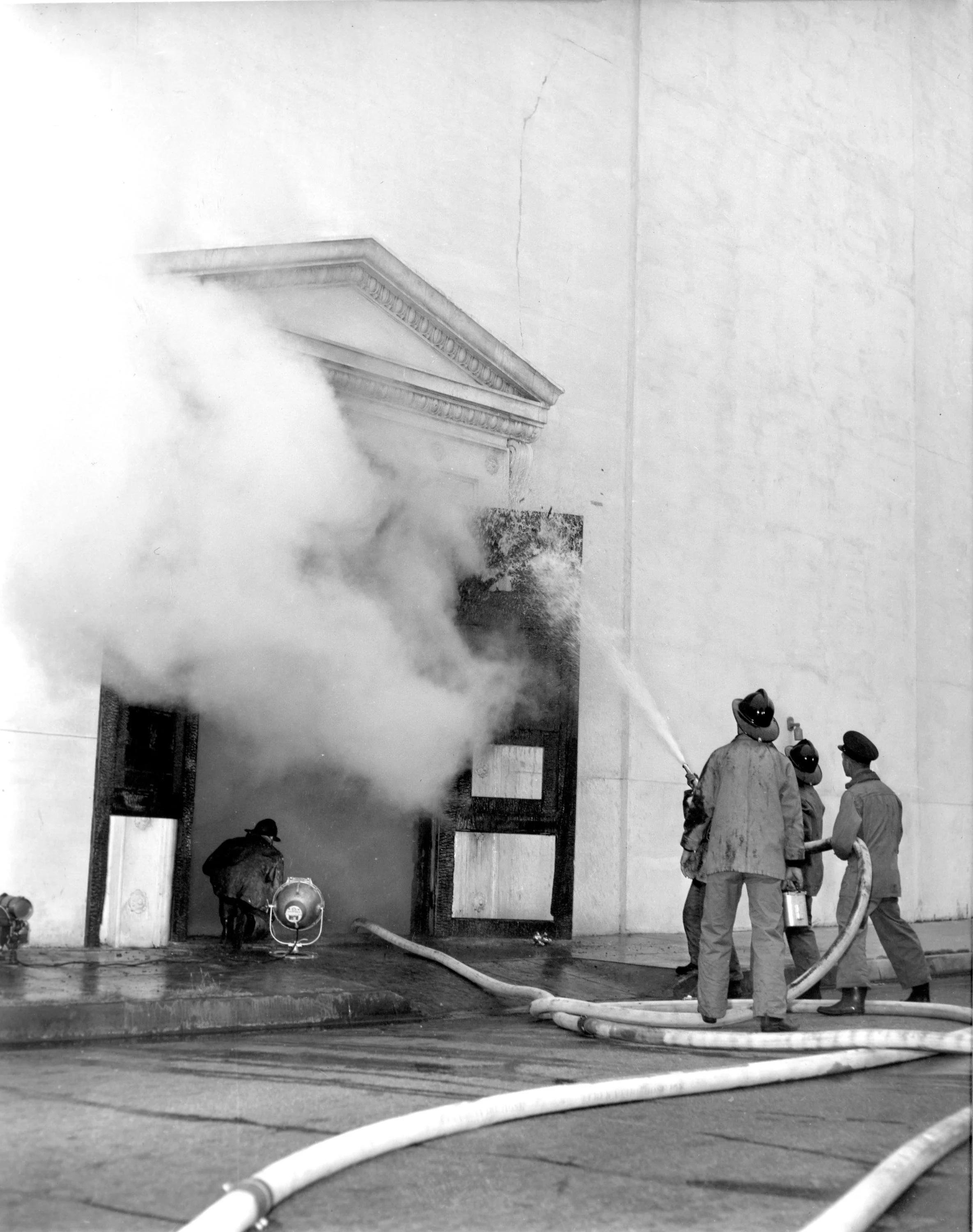
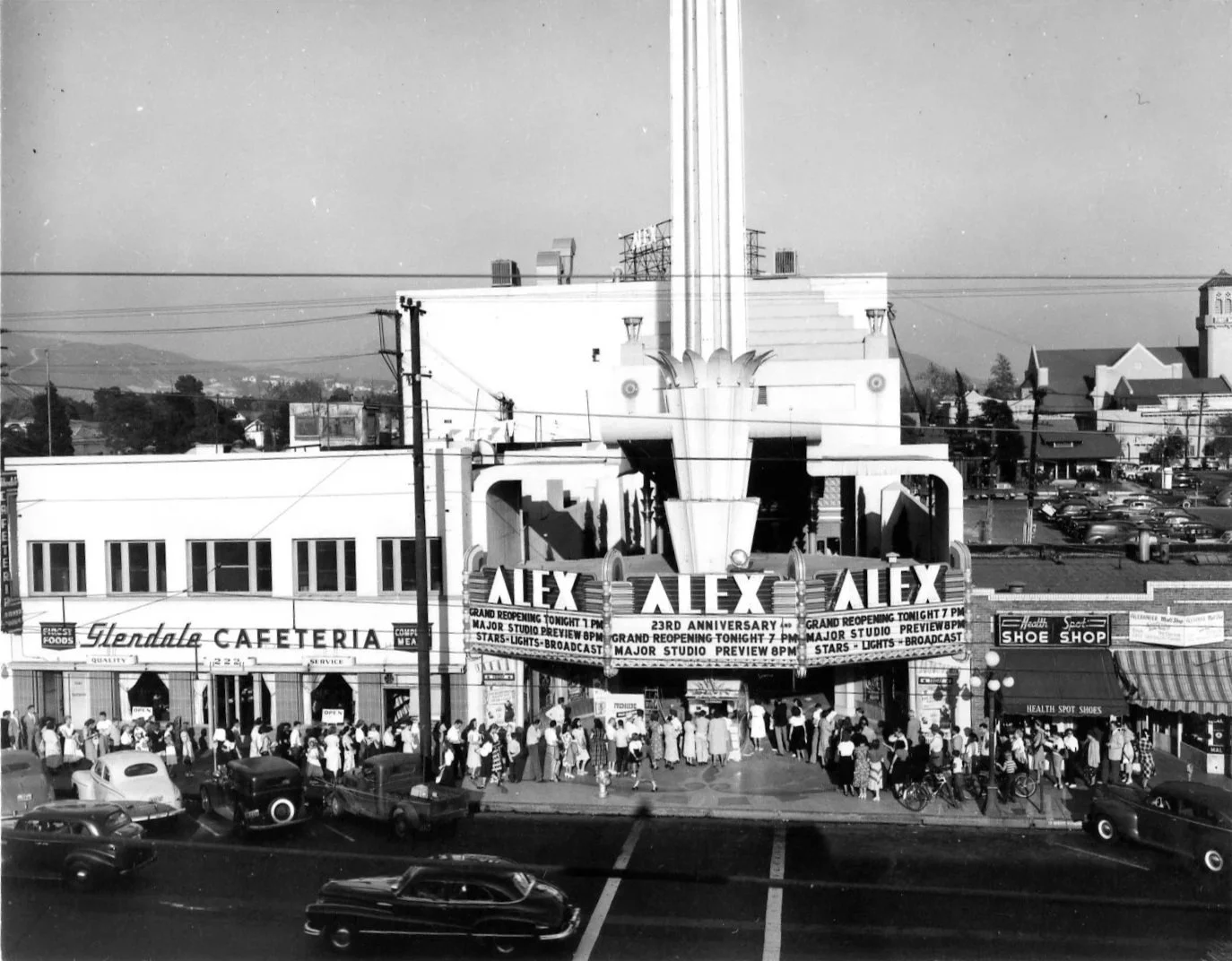
A 1948 fire caused $150,000 worth of damage. During the rebuild, 500 seats were donated to the Glendale Chapter of the Disabled American Veterans for distribution to other local charitable organizations. The Alex re-opened with great fanfare three weeks after the fire, with celebrities on hand to celebrate its 23rd Anniversary.
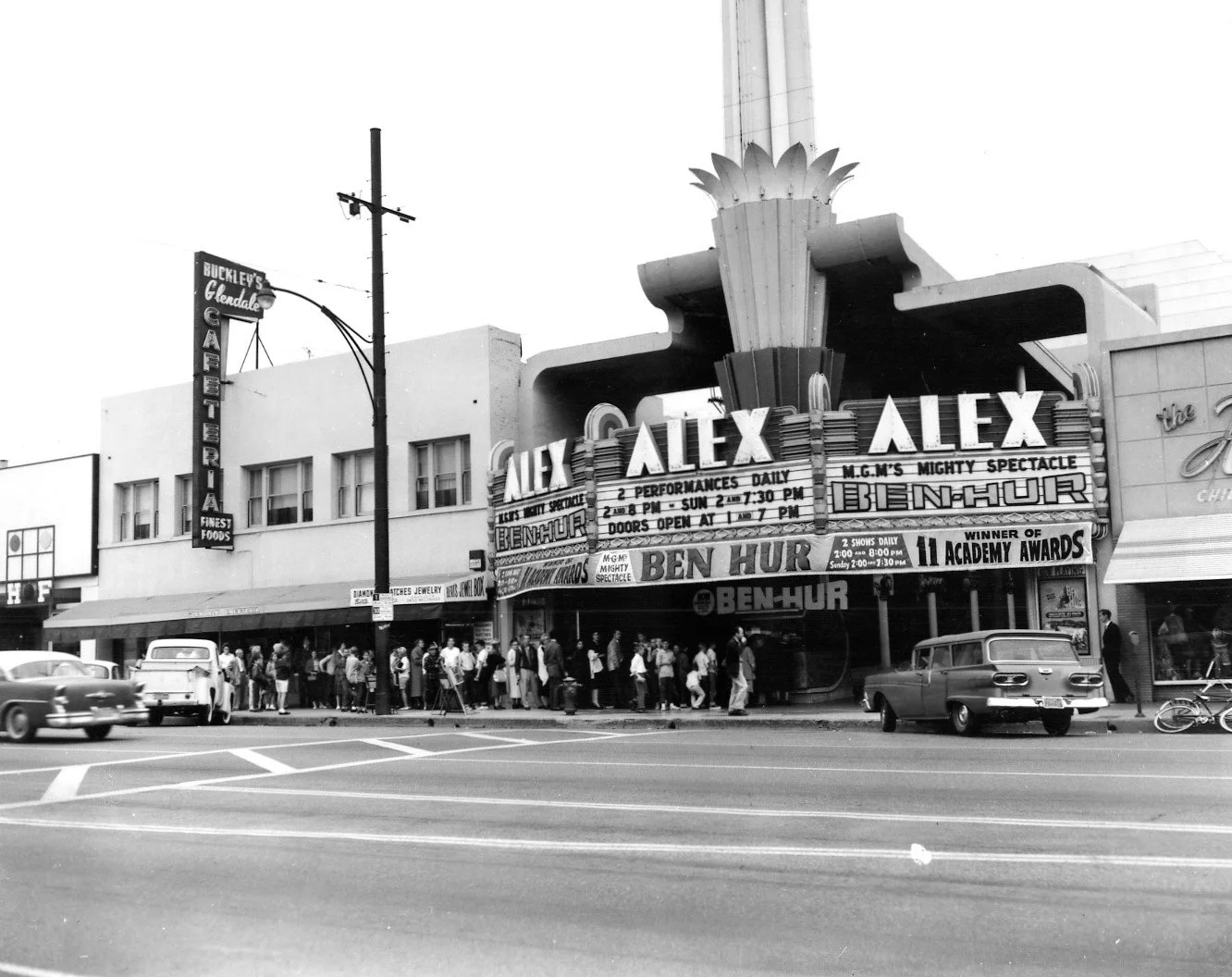
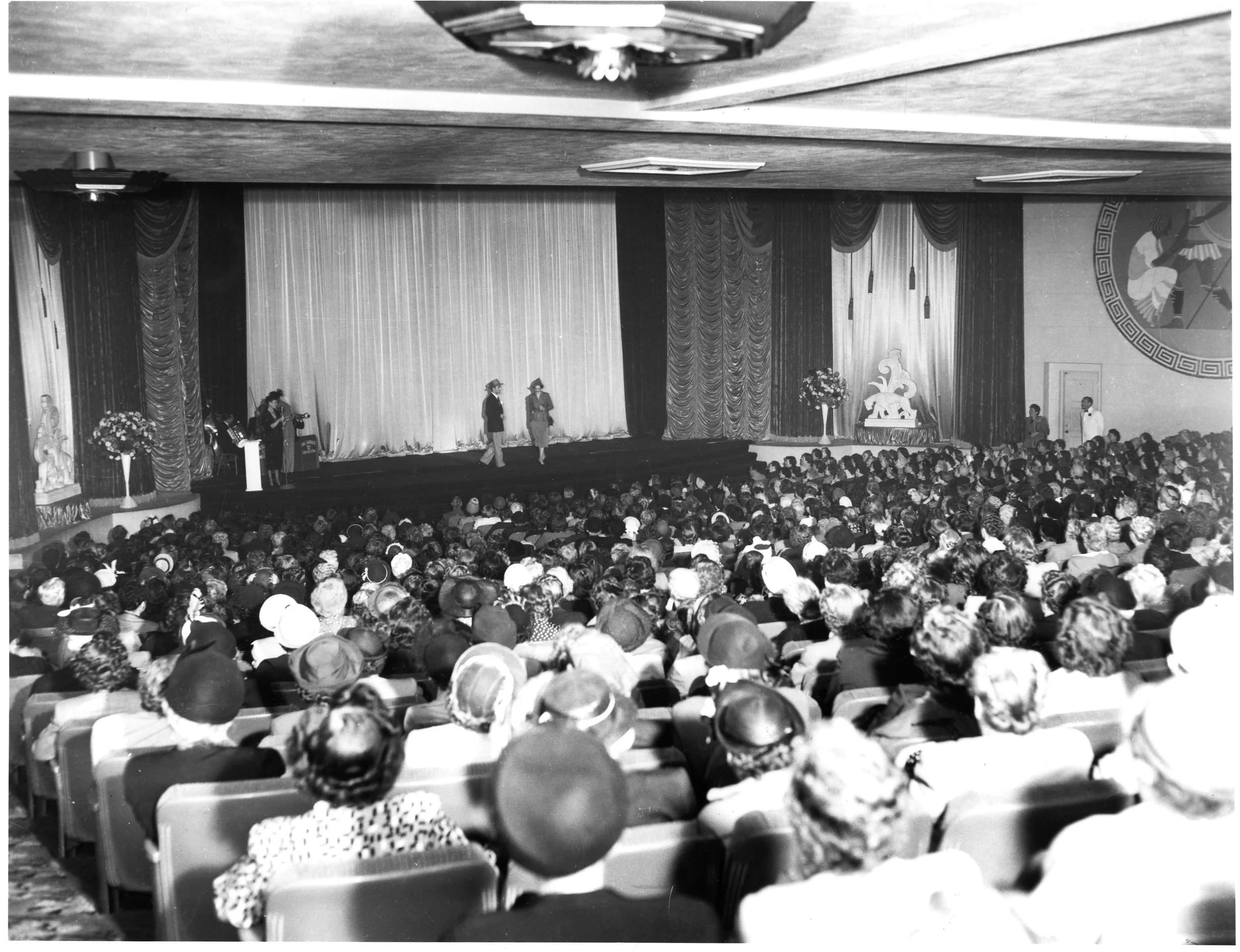
Keeping up with the times, in the mid-1950s, a new, wider screen and surround sound system were installed and blockbusters such as Ben-Hur (1959) were shown. The Alex often opened its doors for civic events, including a 1950 fashion show.
Alex Showing Signs of Age
By 1987, The Glendale Historical Society had celebrated their highly successful renovation of the Doctors House in Brand Park. They turned their sights on the Alex Theatre, by then sixty-plus years old and in need of attention.
The Glendale Redevelopment Agency had previously commissioned a study regarding its possible use for live theater. Consultants Mitze Productions offered three suggestions: minimal refurbishment, refurbishment and extension, and major reconstruction (possibly involving demolition), as noted in a TGHS newsletter of the time.
A team of TGHS volunteers built a case in support of preservation. Led by Steve Preston and without paid staff or financial resources, the group ``spent time deep in Special Collections, where librarian Barbara Boyd helped uncover information. We pulled city records. We used the talents of members with specific expertise that would help us build our case,” Preston noted in a Verdugo Views column, April 21, 2016
Some six months later, the TGHS Task Force presented Position Paper 86-1, "Preservation of the Alex Theatre,” to City Council. Along with a history of the Alex, it included specific comments and recommendations, noting the renewed popularity of large theaters, the evolution of Brand Boulevard into a thriving movie theater district, and its important link to our past. The report also stressed the importance of following preservation guidelines, and noted that the City had not taken any action, despite the theater’s location in the redevelopment area.
The balcony was closed by then, but it still had 1,117 ground-level seats. Owned by Mann Theatres Corporation, it was still showing first-run feature films and attendance had remained steady. The report noted that TGHS considered the Alex to be one of the city's most famous, visible, and heavily used historic resources and that they would continue to monitor its status. Participants were Susan Allison, Catriona Bryan, Georgie Kajer-Weis, Margaret Hammond, Preston, and Greta Reed.
“Although several city council members claimed membership in TGHS,” Preston noted that there had been “only one consistent voice for preservation on the council, the late Ginger Bremberg.” “Our presentations were well received – politely accepted, but usually without any firm commitment to action. Ginger often served as the advocate to keep these issues in the public eye.”
``The Alex struck a chord with many, and the release of TGHS’ report, as raw and modest as it was, helped fuel community support. Eventually, the city engaged in professional studies that later led to the preservation of the Alex,” Preston concluded.
TGHS Raises Support for Alex
Andrea Humberger, who joined the Task Force in January 1988, began attending the city's Historic Preservation Commission meetings and joined the TGHS board of directors in 1990.
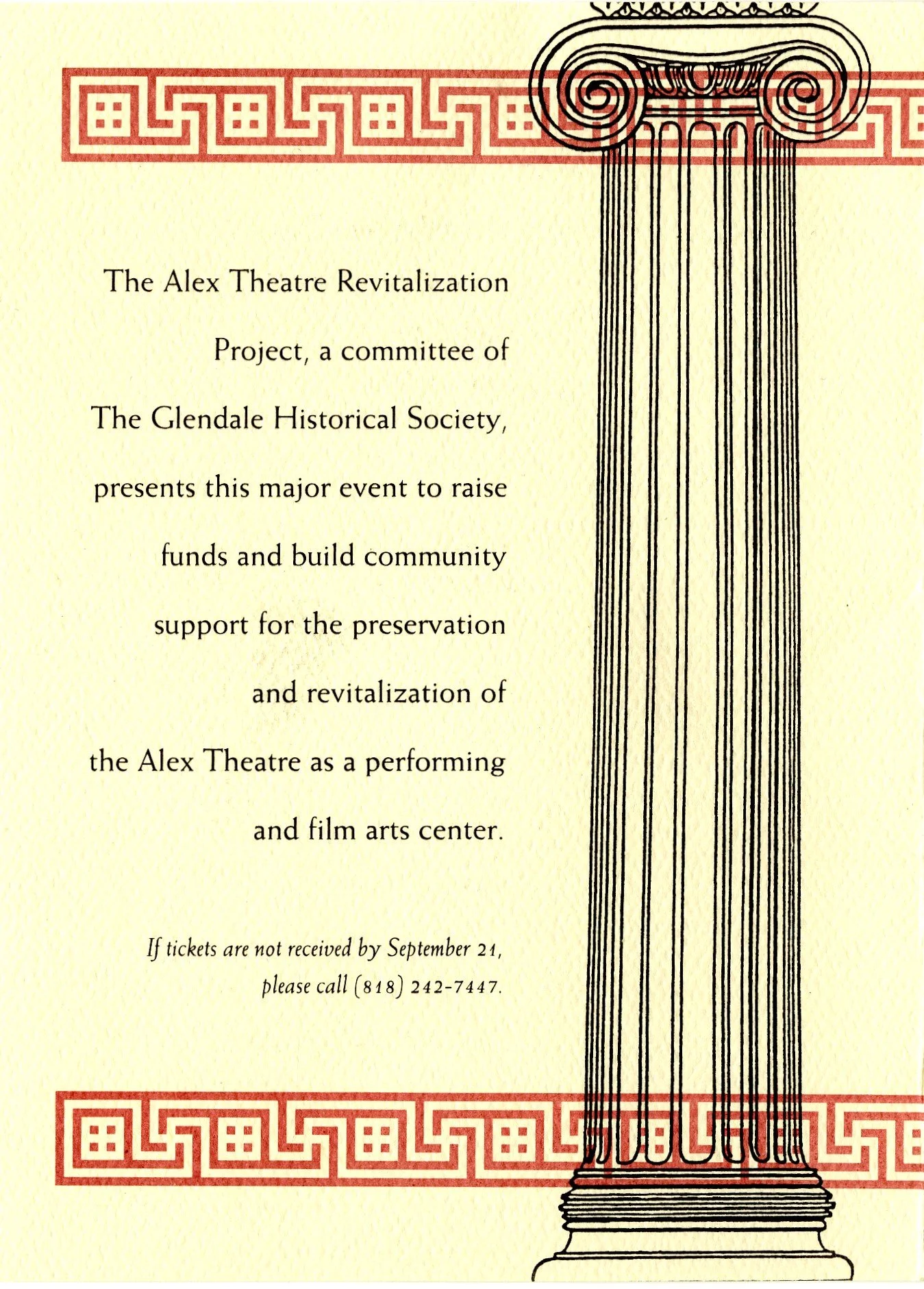
In 1990, a newly formed The Alex Theatre Revitalization Project, including TGHS members David L. Smith, Andrea Humberger, and Connie Humberger, along with Paul Shipton, writer and choreographer; and Ralph Ziegler, CFO of Triad Artists Agency, headed up an event intended to raise both funds and community support for the Alex.
Humberger asked members to write in with their memories of the Alex, or in some cases, the Alexander. Phyllis Matlick Kenney’s memories were printed in the TGHS newsletter:
Just after graduating from Glendale High in 1937, I lied about my age and obtained a job as an usherette at the Alexander, as we called it in those days. We had satin uniforms and changed in the dressing room under the stage. We had many sneak previews as well as "Major Studio Feature Previews" attended by many of the stars. Barbara Stanwyck and Robert Taylor often came in their riding clothes. Mickey Rooney preferred the balcony. Carole Lombard wore such heavy perfume that you could smell her all over the theater. Crowds would line up under the long awning and wait for hours for the stars to appear. No food was sold in the lobby in those days. It was not until Spyrus Skouras, owner of the theater chain, found out that one small theater paid off its mortgage with the money made from selling food that it was introduced. The manager at the time was Fred Harris. There were matinees every day, and besides the cashiers and the doorman, 6 or 8 usherettes. Wages for part time were 40 cents an hour, with $16 a week for a full time 40 hours. That looked like good money, as I was attending Glendale Secretarial School and many jobs were only 25 cents an hour.
A Kick-off party
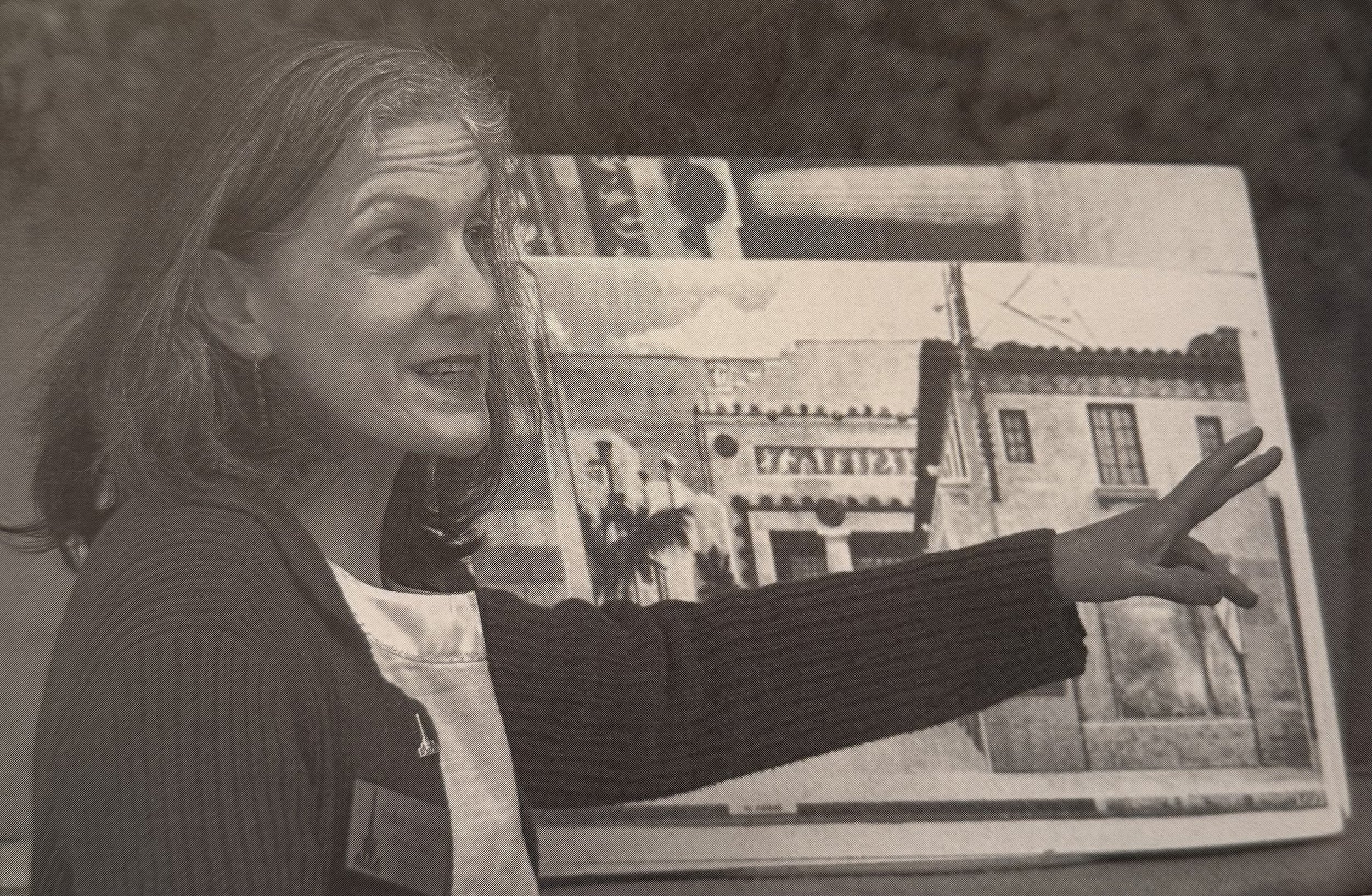
Andrea Humberger
A pre-party, at the Law Offices of Marilyn P. McCumber, overlooking the Alex, brought together ATRP members, the press, local dignitaries and business owners. Master of Ceremonies Jim Brown of NBC introduced Mayor Larry Zarian, along with Humberger, Shipton, and George Crittenden, head projectionist at the Alex. Actors portraying Bing Crosby, Clara Bow, Tarzan, and Cheeta welcomed guests.
Shipton, a Glendale resident, planned a multi-media show based on Bob Caskey, who began working at the Alex in the late 1920s and returned after retiring. His character was played by award-winning actor Russ Marin.
Doctors' House Exhibit
In conjunction with the gala, Doctors' House volunteers assembled a collection of lobby cards of movies which had previewed or played at the Alex, and autographs of movie stars who attended the Alex.
Many of the items came from Glendale resident Joe Ackerman who began collecting in the early 1940s, when he encountered the stars outside Hollywood locations. Also on display were garments representing the decades of the Alex Theatre, loaned by Mary Lilien.
At the opening reception, which drew more than 100 guests, docents, dressed in garments from the 1920s through the 1950s, served as hostesses. Organized by Merry Franzen, docents included Billie Knox, Judy Cabrera, Vesta Agnew, and Denise Tari; Dan Franzen; and volunteers Connie Humberger and Steven Abramians.
Bob Hope Enters the Stage
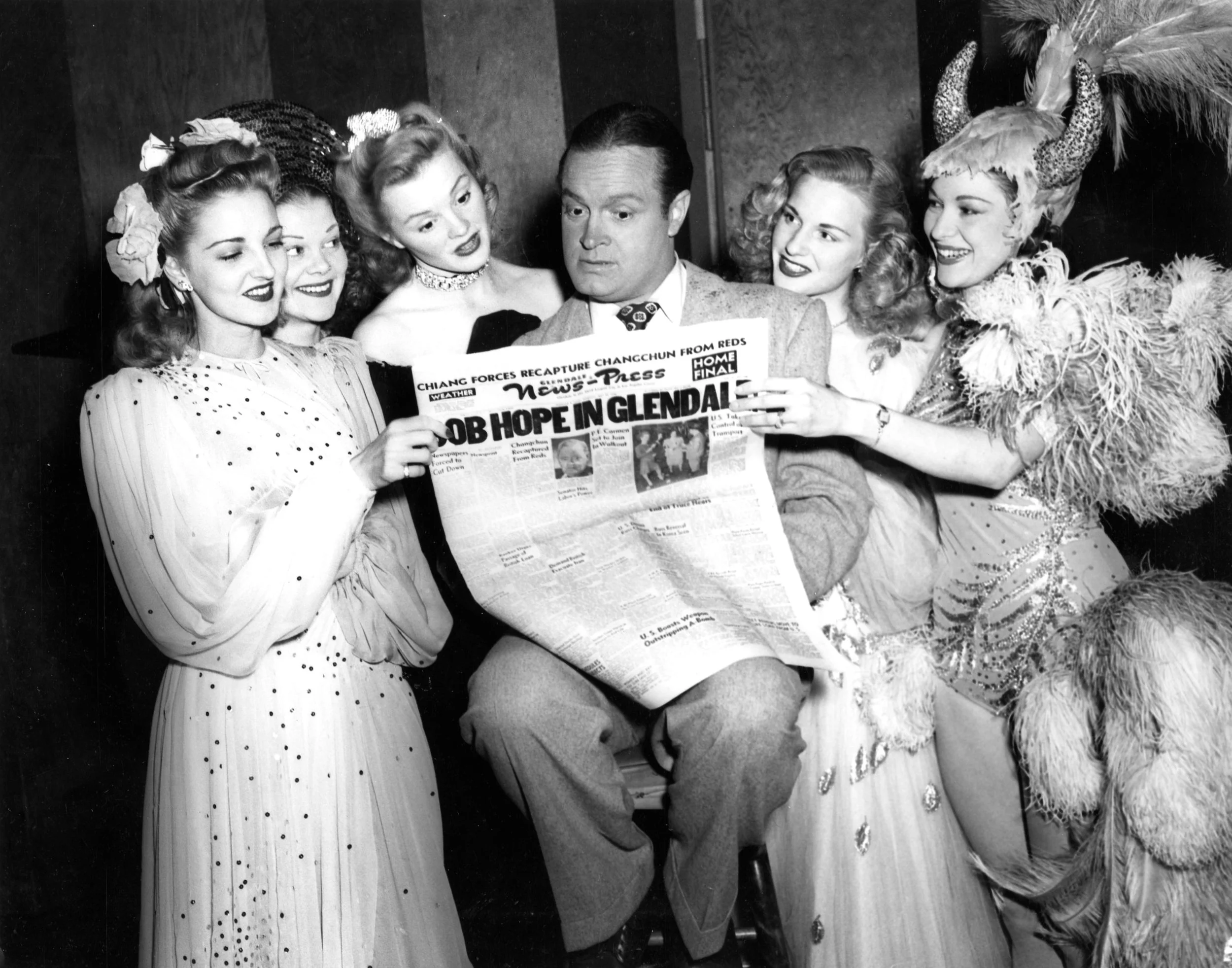
Shipton asked his friend, Ralph Ziegler, of Triad Artists, which represented Hope, to ask if he would serve as Honorary Chairman. Hope “enthusiastically endorsed the Alex fundraiser” and agreed to attend.
It wasn’t the first time that Hope had been in Glendale. One of his first documented visits was in 1946, when he performed at the Civic Auditorium. It was the first stop on a nationwide tour.
"Alexander Then and Now"
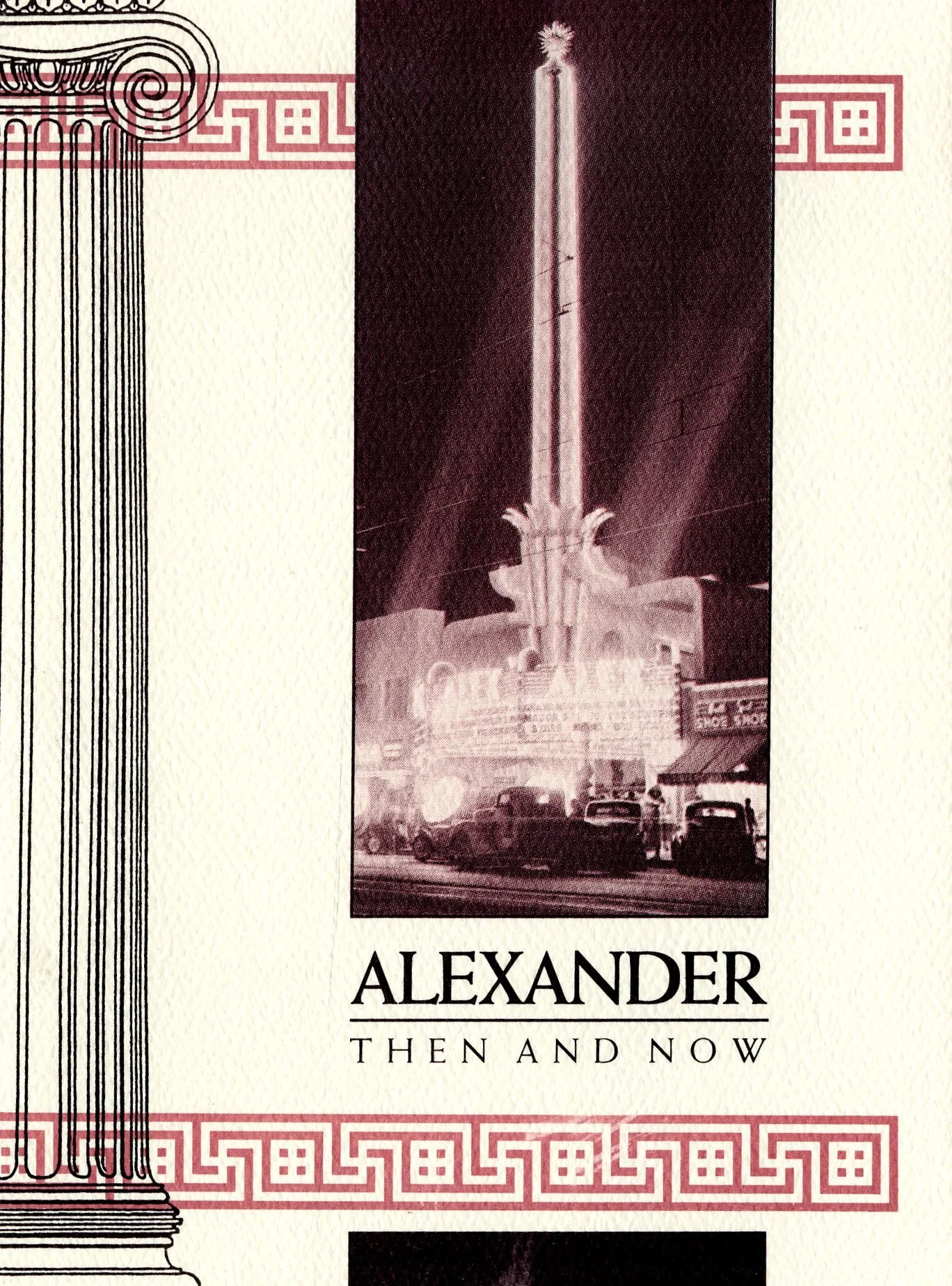
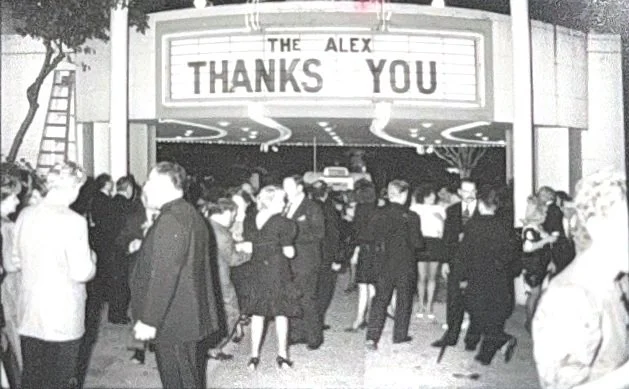
The star-studded review, " Alexander Then and Now,” previewed in September at $15 per person. The next night’s gala, with a champagne reception, at $50 per, brought Hope and more than eighty other celebrity supporters.
Hope mingled with the by-invitation-only audience before the show began. As one of two honorary co-chairs, along with Glendale realtor and developer Don Platz, this writer was thrilled to shake Hope’s hand.

Courtesy of Andrea Humberger
Courtesy of Andrea Humberger
Recognition of TGHS’s role
In the next TGHS newsletter, Humberger noted that the event had exceeded expectations; “raising public awareness and creating a sense of pride in the historical and architectural importance of the landmark Alex Theatre; and alerting the public to its integral role and responsibility in the preservation of the Alex.”
Mayor Larry Zarian presented commendations to the six ATRP members: Karen Burdett, Andrea Humberger, Connie Humberger, Dave Smith, Paul Shipton, and Ralph Ziegler. Later, ATRP brought in theater consultant Daniel L. Pierotti, who recommended that the city support development and ownership of the Alex.
In December 1990, the Glendale Redevelopment Agency resolved that the Alex was "worthy of preservation" and would commit to revitalizing it as a focal point of community and performing arts activities. The new 21-member Committee for Arts at the Alex (CAA), with "individuals representing various organizations who are keenly interested in the future of the Alex,” included TGHS board members Andrea Humberger and Dave Smith.
Bright New Future
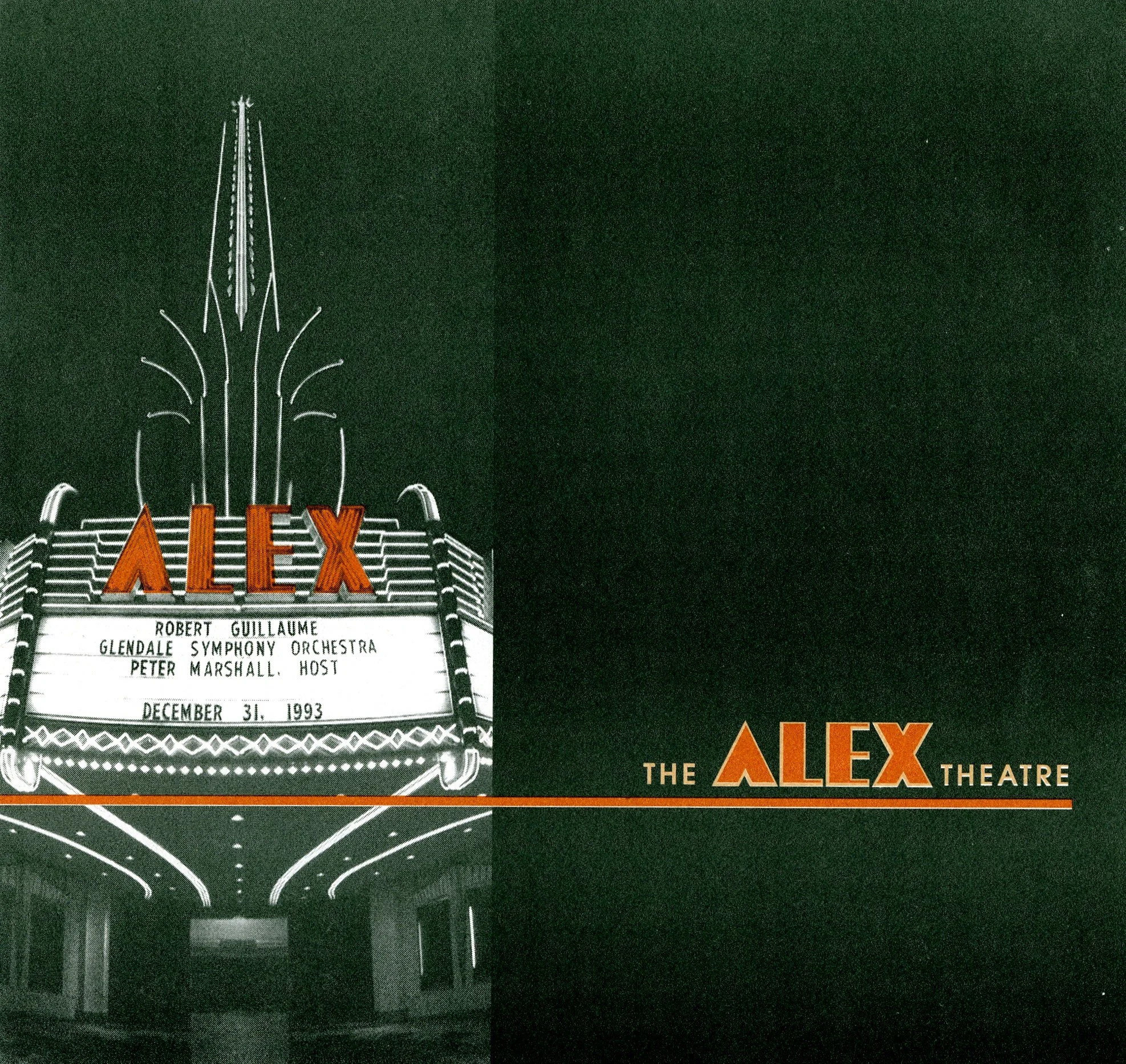
Rehab began in late 1992, with plans to restore the spire to its 1940s splendor. However, the cost of restoring the original sparkling neon effect at the top of the spire was not included in the budget. Hearing this, TGHS donated $5,000 to recreate the “sparkle.”
In 1993, as the project neared completion, the ARTB, formed to manage the theater, planned a New Year's Eve celebration featuring singer Robert Guillaume and the Glendale Symphony Orchestra, along with celebrity host Peter Marshall. Music and dancing in the street, cocktails and hors d'oeuvres, and a countdown to midnight with special effects were added attractions.
Alex Film Society Formed
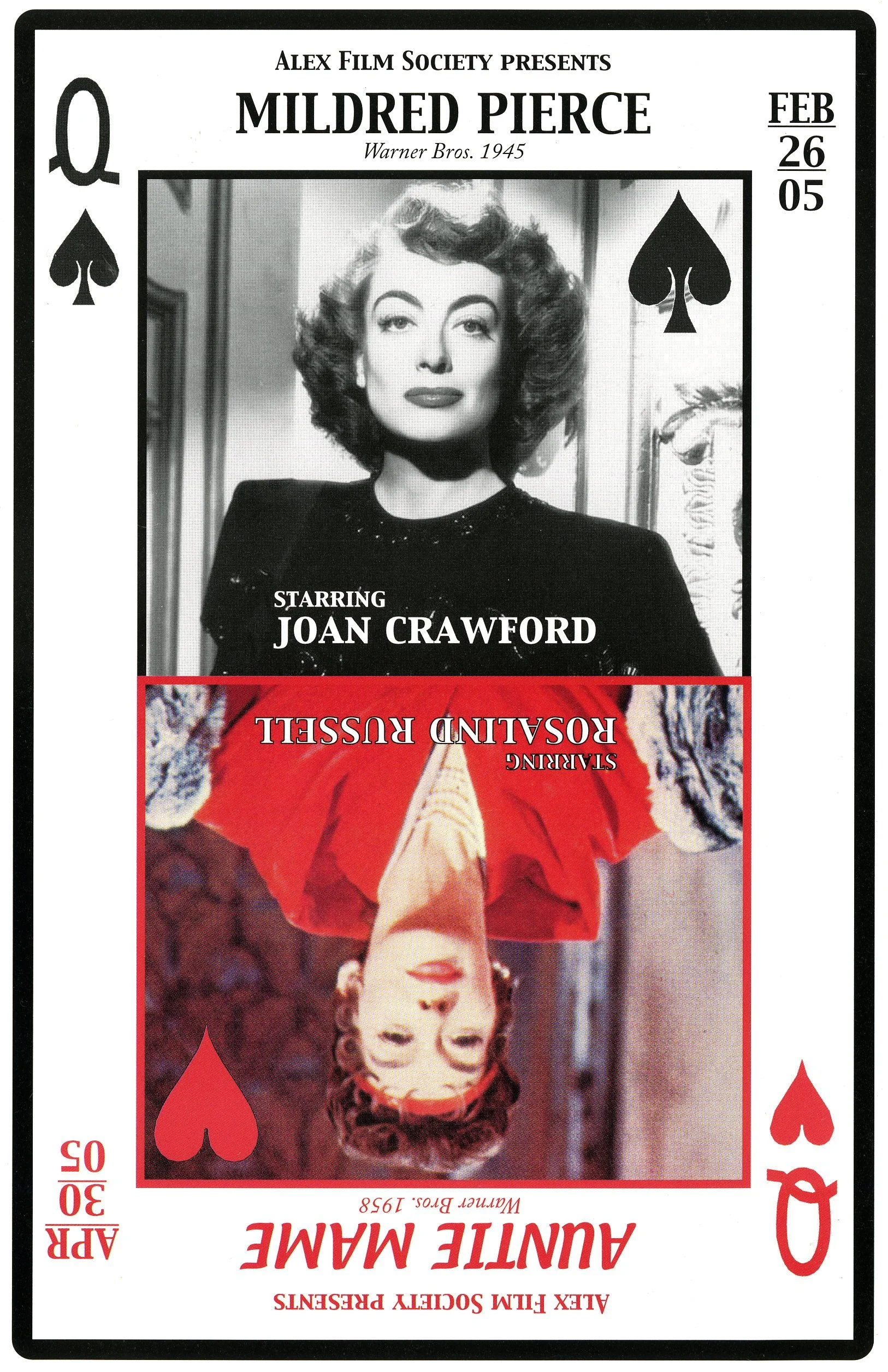
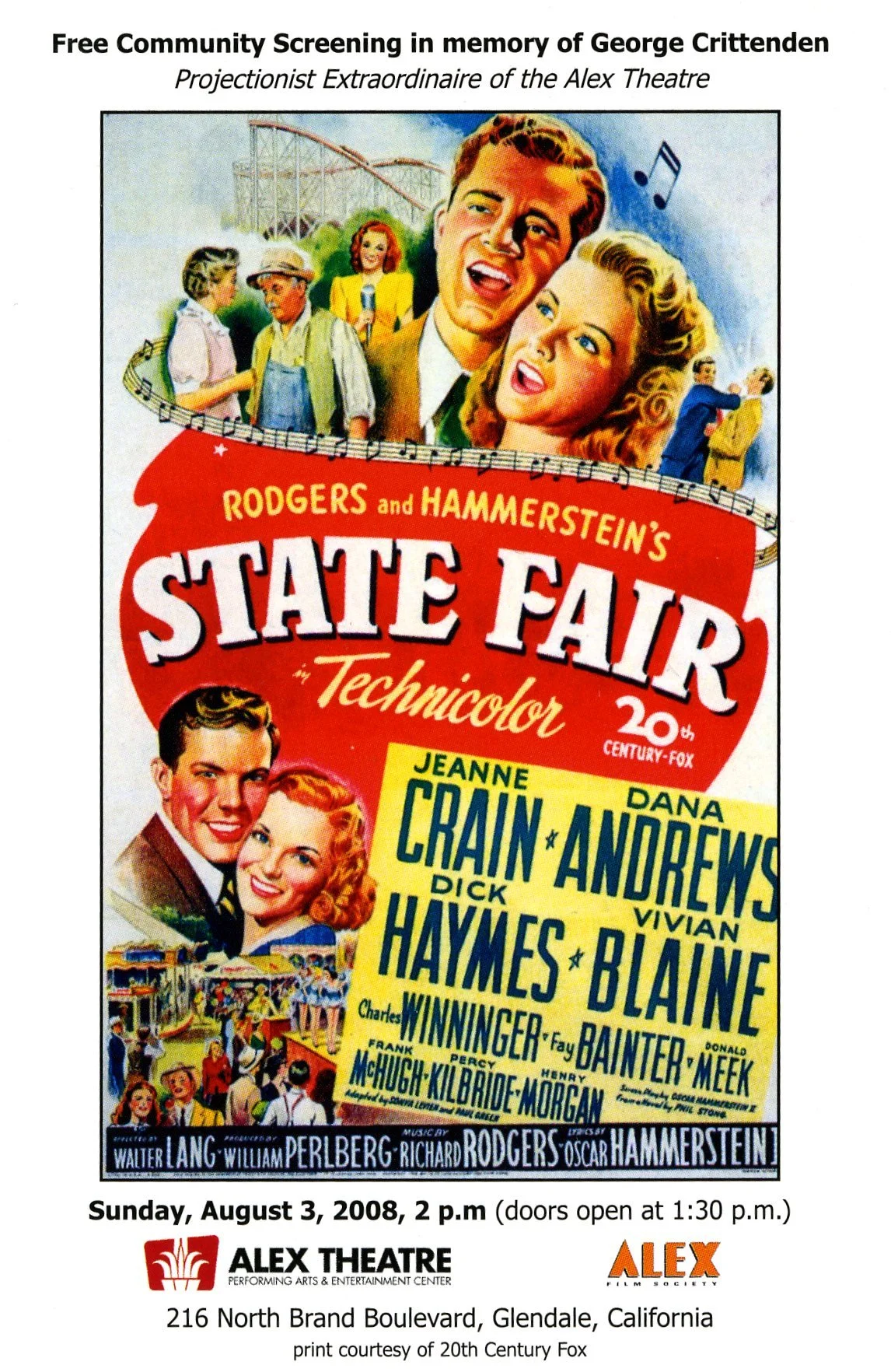
In 1994, a passionate band of film buffs wanted to ensure that classic films would still be shown on the big screen. They were brought together by locals Brian Ellis and Randy Carter, who, in the 1980s, had both worked “on the long running comedy, Cheers.” Members wanted to present films “the way they were meant to be seen,” Carter said. Founding members included Carter, George Crittenden, Brian Ellis, Pam Ellis, Andrea Humberger, Connie Humberger, Barbara Leimeter, Dan Leimeter, and Bob Miller.
They repaired the existing projector, acquired a new set of lenses and got a second projector donated. They also tracked down the original Voice of the Theatre speakers.
Their first event was to be a screening of the original 1939 “Gone With The Wind.” Several surviving cast members, including Ann Rutherford and Rand Brooks, agreed to be there. “Olivia de Havilland sent regards by telegram from her home in Paris. Members of the Selznick family and several actors who portrayed children in the film turned out to salute the classic,” Carter added.
However, major problems arose: the screen wasn’t installed until the day before and the theater couldn’t be accessed for a proper sound check. On opening night, council members and a ‘Who’s Who’ of prominent Glendale residents mingled. Alas, due to technical issues, the movie could not be shown. Instead, Carter and Ellis invited the celebrities on stage and they entertained the crowd with anecdotes for almost two hours. ``Patrons left with broad smiles on their faces and dozens commented that the impromptu talk was the best evening they’ve ever had at a film screening,” Carter added.
Channel 5 reported on the event, without mentioning the sound issues, and the following Sunday they had a line all the way down Brand Boulevard for a “sold out” matinee performance. The AFS entertained audiences for more than twenty-five years.
Glendale Arts Formed
In 2008, the nonprofit Glendale Arts was created to operate and steward the historic theater.
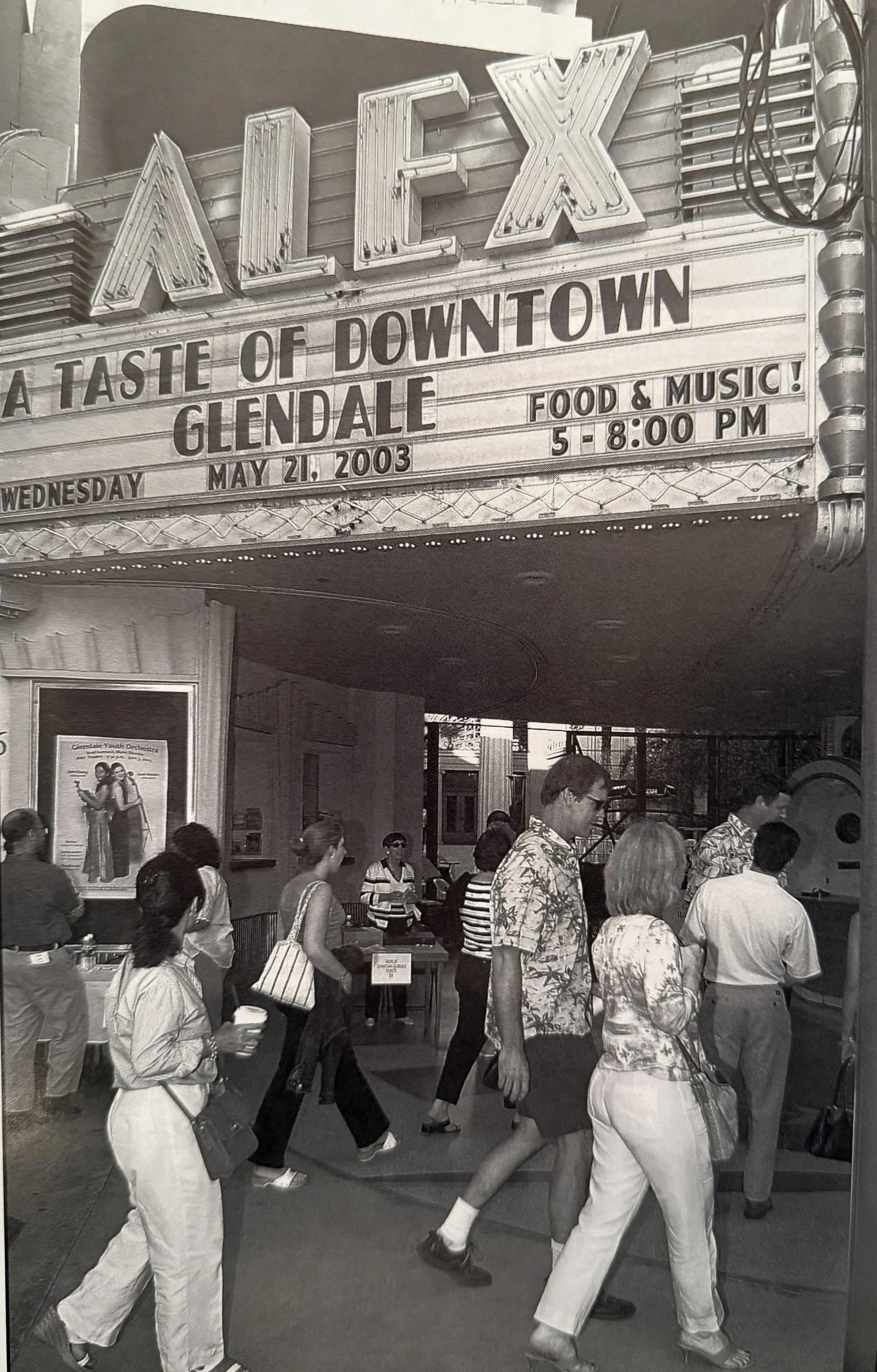
During its tenure, Glendale Arts oversaw tens of thousands of productions and welcomed more than a million visitors, including patrons of the resident companies: the Alex Film Society, Gay Men’s Chorus of Los Angeles, Glendale Youth Orchestra, Los Angeles Ballet, Los Angeles Chamber Orchestra, and Musical Theatre Guild.
The forecourt became a sought-after venue for galas, fundraisers, and receptions, while the stage and auditorium served as a backdrop for numerous film and television productions.
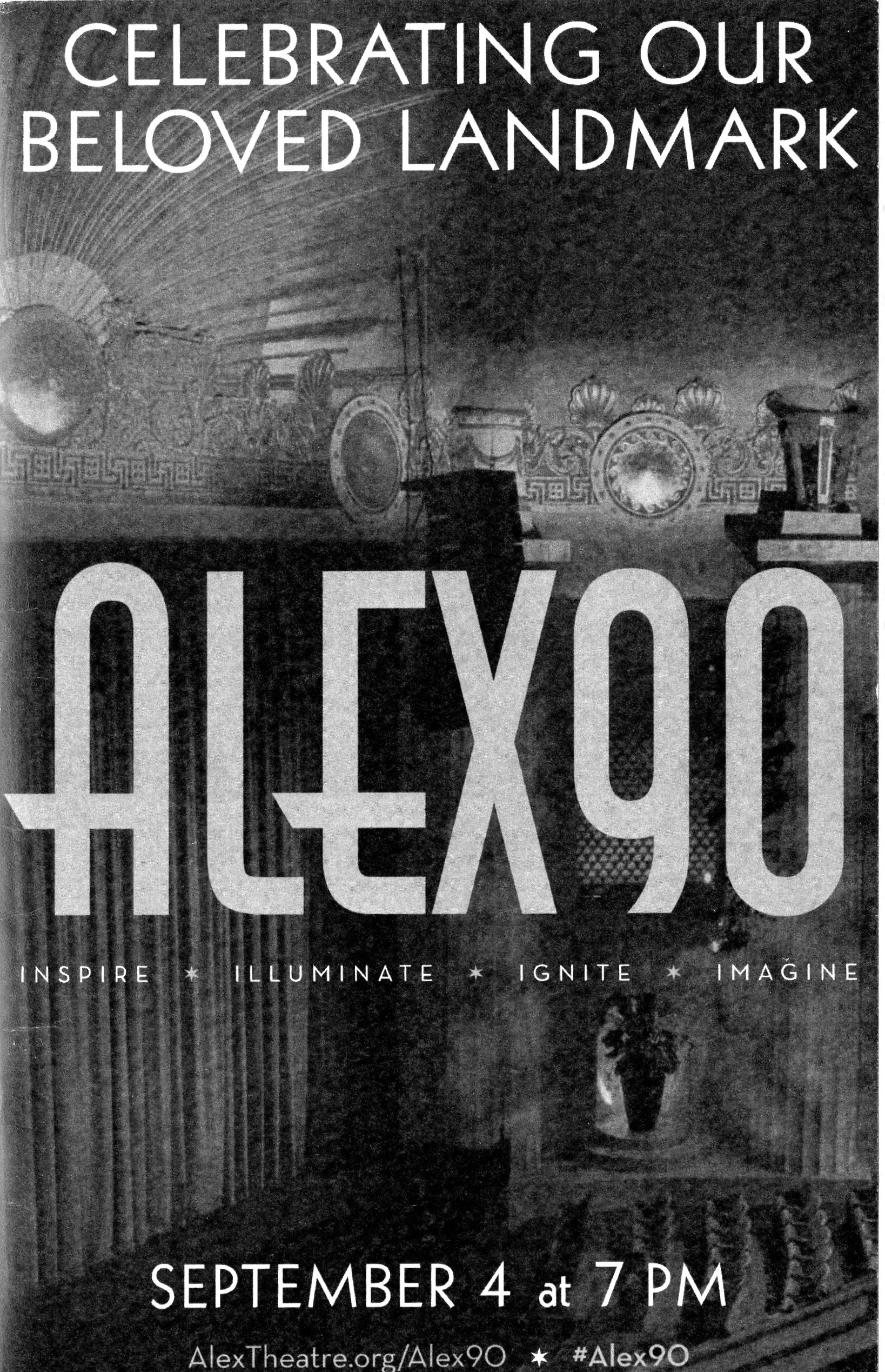
One of Glendale Arts’ most visible contributions was The Illuminate Project, launched in 2015 to celebrate the Alex’s 90th. Through community fundraising and advocacy, GA raised over $75,000 and then matched with its own resources to fully restore the theater’s historic marquee, 100-foot neon tower, and starburst. The relighting of these architectural icons brought community support and recognition from the City Council and elected officials, as noted by Nina Crowe, Chief Executive Officer at Glendale Arts.
For several more years, proceeds from the annual Illuminate Dinner funded maintenance and preservation efforts. The COVID pandemic brought unprecedented challenges, but GA kept the theater connected to the community via digital programming, film and television shoots and carefully planned small-scale events. GA managed the theater until October 2021.
Courtesy of Glendale Arts
Current management
Since 2021, the theater has been under the direction of Miles Williams, founder of the EVNSONG, resident Promoter and Operator of the Alex.
In addition to its resident companies, the Alex has hosted several community events, including recitals by several Glendale-based dance and music studios: Lark Society, Glendale Youth Orchestra, City of Glendale’s Genocide Commemoration, Women’s Equality Day, Tanfis Palestine benefit, Diwali celebration, ALEX Film Society Stooges event, JPL collaboration Blended Worlds, and Hosharian Orchestra Concert.
Williams opened the Alex for an Eaton Fire Relief Benefit hosted by Pasadena Heritage in March. The variety show showcased internationally known artists from the fire zone, many of whom had lost homes, studios and instruments in the fire. The evening was a star-studded, family-friendly variety show, “like an old-fashioned variety show, complete with color guard and National Anthem,” said one audience member. TGHS hosted a VIP Reception, with donations from Porto’s Bakery and Zankou Chicken, accompanied by libations from The Alex Theatre.
Still Standing After All these Years
The Alex, which opened in September 1925, observes its 100th year in September 2025. Several special events are planned to celebrate the Centennial of the legendary theater.
Resources
The Glendale History Room, on the second floor of the Central Library, has city directories dating back to 1906, photographs of early Glendale, and archival collections on the Glendale Unified School District, Forest Lawn, theaters of Glendale and other Glendale-related topics. Visits are by appointment only (please email glendalehistoryroom@glendaleca.gov)
Our local history was studied extensively by early historians, including John Calvin Sherer, who authored ‘History of Glendale and Vicinity’ in 1922. Carroll W. Parcher incorporated much of that information in `Glendale Community Book,’ published in 1957. A later version, ‘Glendale Area History,’ was published in 1974 and expanded in 1981. Unless otherwise noted, much of what is included here is from these books and from “Glendale, A Pictorial History.”
Other Resources
Position Paper No. 88-1, "Preservation of the Alex Theatre" prepared by the TGHS Preservation Action Task Force in April, 1988
Verdugo Views, April 16, 2016
Verdugo Views, June 15, 2019
TGHS Newsletters
VOL. 8, NO. 1, 1987
VOL. 11 NO. 1, 1990
VOL. 11, NO. 2, 1990
VOL. 11, NO. 3, 1990
VOL. 14, NO. 1, 1993
VOL. 14, NO. 2, 1993
Glendale Arts: “Our Conviction for the Alex and for Glendale,” Nina Crowe, CEO Glendale Arts
Altadena & Friends website
City Of Glendale, California, report To The Special City Council agenda Item Report: Annual Alex Theatre Report – Calendar Year 2024.